
Article | July 28, 2026
FFPE as a Discovery Engine: Unlocking New Biology Hidden in the Archives
Every hospital pathology archive holds a resource that drug developers rarely think to mine for discovery: decades of formalin-fixed, paraffin-embedded (FFPE) tissue blocks collected from patients, each one linked to a diagnosis, a treatment course, and often years of clinical follow-up. Hundreds of millions of these blocks are stored worldwide, at room temperature, at a fraction of the cost of a frozen tissue biorepository.
However, due to the degradation effects of formalin fixation on proteins in FFPE samples, this archive has largely been treated as a diagnostic record to be consulted, not a dataset to be mined.
Next-generation mass spectrometry-based proteomics is changing that, enabling retrospective discovery in archived tissue.
FFPE sample archives are vast
but have long been inaccessible to proteomics due to the effects of formalin fixation on protein structures.
10,000+ proteins
can now be measured in a single FFPE section, including phospho- and glyco-proteins, driven by innovations in extraction chemistry and MS.
Retrospective discovery in archived tissue is now possible
for target discovery and validation, patient stratification, and resistance monitoring – all without new tissue collection.
Locked in Formalin, Lost to Discovery
Formalin fixation is what makes FFPE tissue durable enough to sit on a shelf for decades, but the same chemistry that preserves tissue morphology also crosslinks proteins to each other and to surrounding macromolecules to preserve cellular architecture. Those crosslinks mask peptide bonds and distort protein structure, so early attempts to extract and digest protein from FFPE tissue lost significant coverage compared to fresh-frozen material. As a result, the vast majority of discovery proteomics in tissue has been done in fresh-frozen samples, with FFPE being largely reserved for low-plex immunohistochemistry (IHC) analysis, where a validated antibody can still confirm the presence of a target protein following antigen retrieval procedures to ‘unmask’ the protein’s epitopes.
This tradeoff meant that the vast majority of archived tissue – and the clinical history attached to it – sat outside the reach of large-scale, unbiased protein profiling. A compound might show a striking response in a subset of patients, but formalin fixed tissue could not support a comprehensive proteomic look at whether those responders expressed the drug’s target differently, had certain signaling pathways turned on or off, or carried some other protein-level signature that distinguished them from non-responders.
Converging Innovation Cycles Create the Key
Several independent innovation cycles, from advances in protein extraction chemistry and sample preparation to rapid improvements in the speed and sensitivity of high-resolution mass spectrometry (MS), have converged to substantially change what is possible to profile at the protein-level in FFPE tissue. Optimized reversal of formalin crosslinks through ultrasonication – which significantly boosts protein recovery using acoustic cavitation – combined with high-throughput liquid chromatography and modern MS instrumentation now allows more than 10,000 protein groups to be directly measured from a single 5 μm FFPE section, including post-translational modifications (PTMs) such as phosphorylation and glycosylation.
While traditionally discovery proteomics in FFPE tissue would yield considerably fewer detectable proteins compared to fresh-frozen tissue, these advancements have closed the gap. Now, exceptional protein-level concordance with fresh-frozen tissue – with more than 90% protein matching – is readily achievable. This broad and quantitative protein characterization, once inaccessible via proteomics in FFPE samples, offers a fundamentally different value proposition than the single protein, semi-quantitative view that IHC provides. It provides complementary insights that can be integrated with existing IHC and genomics datasets to layer in analysis of functional tumor biology, assay specific protein isoforms, or novel protein targets, building a more complete molecular picture than what any single platform can provide.
This is the same shift that has played out elsewhere in the proteomics field: moving from a targeted, antibody-dependent measurement of one to several proteins to comprehensive, mass spectrometry-based measurement of thousands of proteins, revealing isoforms, modifications, and functional biology that a targeted assay is not readily able to see. Applied to FFPE, it turns an archive built for diagnosis into a substrate for novel discovery.
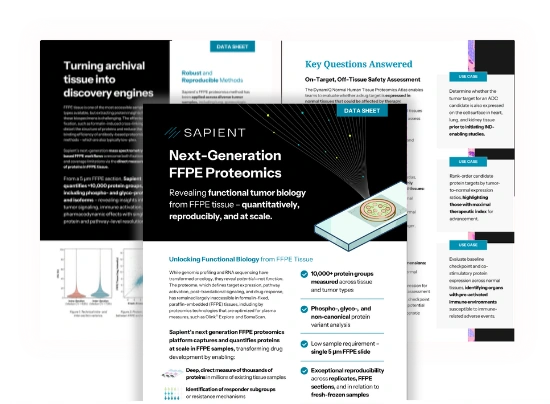
From Static Blocks to Discovery Engines
Now that FFPE tissue can be measured with comparable depth of protein coverage as fresh-frozen samples, millions of existing archived tissue sections can be re-analyzed to become an active input to a new drug program. Four applications show what that shift looks like in practice, each a form of retrospective discovery in archived tissue:
Retrospective target discovery and validation.
Clinical trial cohorts and tumor banks accumulate FFPE tissue with outcome data attached, sometimes added years after the original collection. FFPE proteomics allows researchers to go back to these archives to uncover important new findings that were previously hidden to analytical tools available at the time of their collection. Archived tissue, even years or decades old, can be interrogated directly for target expression, response biomarkers, or resistance mechanisms, without waiting for a new prospective collection of frozen tissue to accrue enough patients and follow-up time.
Identification of surface targets for ADC, T cell engager, and radioligand therapies.
Cell surface proteomics workflows built for tumor target discovery can now be applied directly in FFPE tissue for broad profiling of surface-accessible druggable targets – which is key to advancing these new precision drug modalities. And, because most well-annotated tumor banks are stored as FFPE, candidate cell surface targets can be evaluated in tissue with the richest clinical annotation available, not just the smaller subset that happened to be frozen.
Patient stratification and companion diagnostic development.
Because FFPE is the tissue format most consistent with routine clinical practice, biomarker signatures discovered in FFPE proteomic studies translate more directly into assays that can eventually run on the same tissue type a pathology lab already collects, shortening the path from discovery to a clinically deployable test.
Mechanism of resistance and immune evasion monitoring.
Matched pre- and post-treatment FFPE samples, when available, let researchers track how the proteome of a tumor changes under therapeutic pressure using tissue that was collected as part of standard care rather than a dedicated research protocol.
FFPE Proteomics Reveals Novel Biology
The biology locked in archival FFPE tissue was never inaccessible because it did not exist. The tools to measure it comprehensively were missing. With mass spectrometry now capable of extracting thousands of proteins, along with their modifications and isoforms, from a single stored FFPE section, the potential for new discovery in archived tissue is immense.
Tissue collected years ago, tied to real patient outcomes, is now available for the same de novo discovery work that has historically required fresh, prospectively collected samples. FFPE sample archives have inherently become more valuable now with the right method available to measure proteins once inaccessible but always biologically informative.
Sapient Bioanalytics is a CRO building the workflows to support the next generation of precision medicine – including with next-generation FFPE proteomics method capable of measuring thousands of proteins and their PTMs directly from archived tissue. If you are interested is discussing how we can enable retrospective discovery in your archived tissue, we welcome you to schedule a time to meet with our scientists.
Summary of Key Questions Addressed
What is FFPE proteomics?
FFPE proteomics is the use of mass spectrometry to measure proteins directly from formalin-fixed, paraffin-embedded tissue. It moves beyond antibody-based methods like IHC, which are targeted, low-plex assays, to enable comprehensive profiling across thousands of proteins at a time – including their modifications and isoforms – from tissue that has been chemically preserved rather than frozen.
How many proteins can be measured from an FFPE sample?
Modern FFPE proteomics workflows can measure more than 10,000 protein groups from a single 5 µm section, including post-translational modifications (PTMs) such as phosphorylation and glycosylation. This level of coverage now achieves better than 90% concordance with matched fresh-frozen tissue.
How is FFPE proteomics different from IHC?
IHC is a targeted method that confirms the presence of one or several proteins at a time using validated antibodies, read out via imaging for semi-quantitative results. FFPE proteomics is untargeted and quantitative, measuring thousands of proteins simultaneously and revealing isoforms and modifications that antibody-based methods cannot readily resolve. And, because mass spectrometry-based proteomics relies on peptide sequencing rather than antibodies, it avoids cross-reactivity, clone variability, and fixation-related epitope loss challenges that can plague antibody-based methods.
Why does FFPE proteomics matter for drug development?
Most well-annotated clinical tissue is stored in FFPE form rather than as frozen samples. FFPE proteomics allows this vast inventory of existing archived tissue, often linked to years of clinical outcome data, to be used for retrospective target validation, biomarker discovery, and patient stratification without waiting for new prospective sample collection. The tools that were missing to access the proteome in these stored samples at the time of their acquisition are now available, and can be applied to rapidly unlock novel biology informing future studies.