
White Paper | June 30, 2026
De-Risking ADC Target Selection: A Cell Surface Proteomics Approach
Get the Resource
White Paper Download - De-risking ADC Target Selection
"*" indicates required fields
Antibody-drug conjugates (ADCs) have become one of the most productive modalities in modern oncology, with more than a dozen approvals and a rapidly expanding pipeline. Yet the failure rate for these programs remains high, and poor ADC target selection is consistently among the leading causes.
The core problem is that the most widely used target selection tools – gene expression databases, RNA sequencing, and immunohistochemistry (IHC) – do not directly measure the key conditions that make an ADC target viable: a protein that is physically present at the tumor cell surface, abundant enough to drive effective payload delivery, and sufficiently selective relative to normal tissues to define a large enough therapeutic window.
Cell surface proteomics fills that gap. By directly capturing and quantifying proteins at the extracellular surface of human tumor tissue, it provides the protein-level evidence that genomic approaches alone cannot.
Emerging workflows built specifically for this application – combining selective surface enrichment, glycoproteomic strategies, and deep data-independent acquisition (DIA) mass spectrometry – are now enabling surface mapping at a scale and depth not previously achievable across broad panels of tumor and normal tissues.
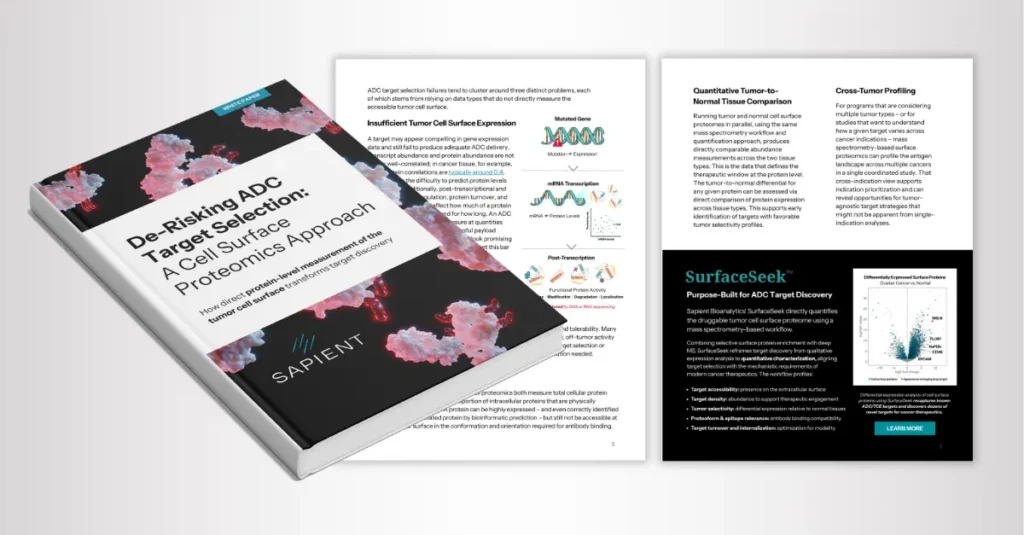
This white paper delves into the root causes of ADC target selection challenges, what mass spectrometry-based cell surface proteomics can specifically reveal in identifying truly accessible and actionable protein targets on the extracellular surface, and how these workflows have been applied across human tumor and normal tissue samples to enable more confident, evidence-based target prioritization.
ADC Target Selection Opportunities and Pitfalls Explored in the White Paper
The ADC Target Selection Problem
Target selection is among the earliest and highest-leverage decisions in an ADC program – and the one most likely to determine whether the program succeeds or fails. The white paper examines why the challenge is not a lack of candidate targets (genomic analyses routinely surface hundreds of differentially expressed genes), but rather in translation: selected protein targets are often found to have insufficient surface expression on tumor cells, or excessive expression in normal tissues – risks that are uncovered only after the program has advanced to later phases.
The white paper details three distinct failure modes: insufficient tumor cell surface expression, normal tissue expression that narrows the therapeutic window, and lack of true surface accessibility.
What Mass Spectrometry-Based Cell Surface Proteomics Reveals
Mass spectrometry-based cell surface proteomics directly quantifies proteins at the extracellular surface of cells – answering the questions that gene expression data and standard proteomics cannot accurately characterize: what proteins are physically present at the tumor cell surface, at what abundance, and how does this compare to normal cells?
The white paper covers four key capabilities: comprehensive, unbiased surface antigen mapping across hundreds to thousands of proteins simultaneously; glycoproteomic enrichment for membrane protein coverage; quantitative tumor-to-normal tissue comparison to define the therapeutic window at the protein level; and cross-tumor profiling to support indication prioritization.
SurfaceSeek™: Purpose-Built for ADC Target Discovery
Sapient Bioanalytics’ SurfaceSeek directly quantifies the druggable tumor cell surface proteome using a mass spectrometry-based workflow.
The white paper explains how SurfaceSeek reframes target discovery from qualitative expression analysis to quantitative characterization, profiling target accessibility (presence on the extracellular surface), target density (abundance to support therapeutic engagement), tumor selectivity (differential expression relative to normal tissues), proteoform and epitope relevance (antibody binding compatibility), and target turnover and internalization (modality compatibility).
Beyond ADCs: Radioligand Therapies and T-Cell Engagers
The white paper also addresses how programs developing radioligand therapies, T-cell engagers, and protein degraders benefit from the same quantitative surface mapping – identifying tumor-selective candidates and normal tissue comparators in a single, coordinated experiment.
Why This Matters for ADC Drug Development Teams
The decision of which ADC targets to advance is made early but determines clinical outcomes years later. For teams designing target identification strategies or re-evaluating programs that have struggled to translate genomic signals into clinical success, the white paper explains how mass spectrometry-based cell surface proteomics now delivers:
- Unbiased discovery of tumor cell surface targets, profiling hundreds to thousands of proteins profiled simultaneously – without predefined panels
- Direct evidence of true surface accessibility with glycoproteomic enrichment to confirm proteins are physically present at the extracellular surface and in the conformation required for antibody binding
- Resolution of proteoforms and protein isoforms that affinity-based assays collapse into a single readout
- Quantitative tumor-to-normal differential analysis for protein-level therapeutic window assessment, enabling early identification of on-target, off-tissue toxicity risk
- Patient-level heterogeneity assessment through direct characterization of expression in human tumor samples to define the proportion of patients likely to respond and inform clinical trial eligibility
Through the white paper, you will learn why cell surface proteomics is becoming a foundational capability across the oncology drug development toolkit.
Complete the form to access the full white paper!
FAQs Addressed in the White Paper
What is the best approach for identifying druggable cell surface proteins?
Gene expression database analysis and RNA sequencing can identify proteins differentially expressed between diseased and normal samples, generating an initial candidate list – but while these methods are fast and cost-effective, but they do not confirm whether a protein is actually accessible at the cell surface for binding, which is essential for surface-directed drug modalities like ADCs, radioligand therapies, and T-cell engagers. The most reliable approach for this critical step is direct, mass spectrometry-based measurement of the tumor cell surface proteome.
Purpose-built workflows use glycoproteomic enrichment – selectively capturing N-linked glycosylated proteins that have completed trafficking and are exposed at the extracellular surface – combined with deep data-independent acquisition (DIA) mass spectrometry. This identifies and quantifies hundreds to thousands of surface-exposed proteins simultaneously across primary tumor and normal tissue samples, without requiring predefined panels or antibody reagents. The result is a direct, quantitative map of which proteins are present at the tumor cell surface, at what abundance, and how that compares to normal tissue – key inputs that are most predictive of whether a target is tractable for surface-directed therapy.
Sapient’s SurfaceSeek™ applies this approach, combining selective surface enrichment with deep MS to directly profile the druggable tumor cell surface proteome across human tumor and normal tissue samples.
Why do ADC drug candidates often fail in late-stage clinical trials?
Late-stage ADC failures tend to cluster around three distinct problems, each stemming from reliance on data types that do not directly measure the accessible tumor cell surface.
First, insufficient tumor cell surface expression: RNA-protein correlations in cancer tissue are typically around 0.4, meaning transcript data is a poor predictor of actual surface protein density.
Second, normal tissue expression that narrows the therapeutic window: many programs have encountered dose-limiting toxicities driven by on-target, off-tumor activity against normal tissue that was either underappreciated at target selection or assessed only with IHC data lacking quantitative resolution.
Third, lack of true surface accessibility: a protein can be highly expressed and correctly identified as membrane-associated by bioinformatic prediction, but still not be accessible at the extracellular surface in the conformation required for antibody binding. Because target selection decisions have largely relied on gene expression databases or IHC rather than direct, quantitative measurement of the accessible cell surface proteome, these risks are typically uncovered only after the program has advanced to later phases.
These factors all contribute to the increasing application of mass spectrometry-based cell surface proteomics in oncology R&D programs, enabling teams to gather direct evidence of target accessibility, target density, and tumor selectivity to inform early ADC target selection.
How does cell surface proteomics differ from standard whole-cell proteomics or IHC?
Standard whole-cell proteomics measures total cellular protein content, which includes a large proportion of intracellular proteins physically inaccessible to an ADC antibody. IHC provides spatial context but is low-throughput, not quantitative, and limited to proteins for which validated antibody reagents exist.
By comparison, cell surface proteomics isolates and measures only the proteins accessible at the extracellular membrane surface, and can be used for discovery to assay hundreds to thousands of cell surface proteins simultaneously – without the need for antibodies or predefined panels.
For example, Sapient’s SurfaceSeek is a mass spectrometry-based cell surface proteomics workflow that uses selective enrichment of N-linked glycosylated proteins to restrict analysis specifically to those proteins confirmed to be accessible at the extracellular surface – removing the intracellular background that inflates candidate lists in standard proteomics workflows.
Can cell surface proteomics be applied across multiple tumor types?
Yes. For programs evaluating multiple indications, or studies characterizing how a given target varies across cancer types, mass spectrometry-based surface proteomics can profile the antigen landscape across multiple tumors in a single coordinated study. This cross-indication view supports indication prioritization and can reveal opportunities for tumor-agnostic target strategies that would not be apparent from single-indication analyses. The same approach applies to radioligand therapies and T-cell engagers, which share the same core requirement: a tumor-associated antigen accessible at the cell surface.
Where does cell surface proteomics fit in the ADC development pipeline?
While target selection is among the earliest decisions in an ADC program, it can have the most long-term influence on whether the program ultimately succeeds or fails. That is why cell surface proteomics adds the most value at the target identification stage — where foundational decisions are made that determine clinical outcomes years later.
Providing oncology teams with direct protein-level evidence to confirm surface accessibility, rank by tumor expression, apply tumor-to-normal differential filters, and assess patient-level heterogeneity, mass spectrometry-based cell surface proteomics enables comprehensive evaluation and prioritization of target candidates before programs commit significant resources. This de-risks selection of ADC targets that may not have favorable safety profiles early in development.
It is important to note that target lists generated from surface proteomics can be further contextualized by integration with complementary mass spectrometry-based workflows that characterize additional dimensions of tumor biology. For example, Sapient offers SurfaceSeek within its broader Tumor Protein Mapping Platform, which includes SignalingSeek™ to assess signaling activation; ImmuneSeek™ to characterize the immune microenvironment context, and ResistanceSeek™ to identify proteomic signatures associated with resistance mechanisms.
Together, these datasets provide a multi-dimensional picture of target and tumor biology that goes beyond surface accessibility to encompass tumor fitness, pathway dependence, and potential resistance liabilities.
Get the Resource
White Paper Download - De-risking ADC Target Selection
"*" indicates required fields