For the first decade of proteomics as a research discipline, antibody- and aptamer-based platforms held the practical advantage. They were fast, scalable, and reproducible enough for discovery work. Mass spectrometry-based proteomics had genuine theoretical strengths – no reagent dependency, direct sequence-level protein identity confirmation, no panel limitations – but the method was slow, required large sample volumes, and the data could take days to weeks to process.
That practical gap shaped how an entire generation of drug development programs approached protein-level biology, as many teams turned to affinity-based panels as the most operationally accessible option.
That landscape has now fundamentally changed.
Three independent innovation cycles – spanning sample preparation, instrument engineering, and computational infrastructure – have converged over the last several years to close the gap between what mass spectrometry could theoretically deliver and what it now routinely achieves at scale.
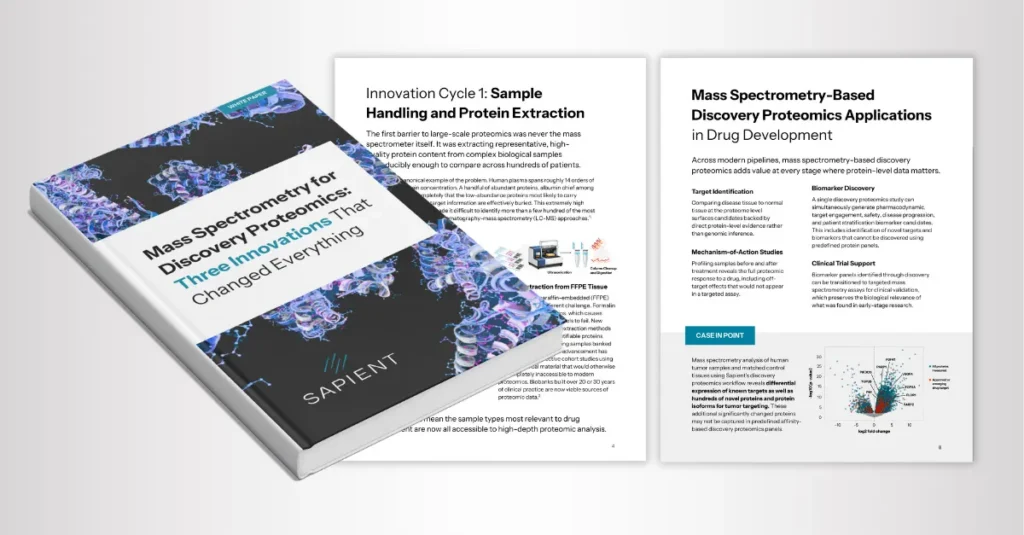
This white paper walks through the three enabling innovation cycles and their practical implications for drug development teams evaluating discovery proteomics platforms.
Mass Spectrometry-Based Proteomics Innovation Cycles Explored
Innovation Cycle 1: Sample Handling and Protein Extraction
The first barrier to large-scale proteomics was not the mass spectrometer itself; it was extracting representative protein content from complex biological matrices such as plasma, tumor tissue, and archived FFPE blocks reproducibly enough to compare across large patient cohorts. The white paper details how new extraction and enrichment approaches have made the sample types most relevant to drug development fully accessible to deep proteomic analysis via mass spectrometry.
Innovation Cycle 2: Mass Spectrometry Hardware
Speed, sensitivity, robustness, and the shift to data-independent acquisition (DIA) have each improved substantially – and the gains compound. The white paper examines how modern mass spectrometry instruments have moved from specialist research tools to platforms capable of supporting clinical-scale cohort studies.
Innovation Cycle 3: Software and Computational Infrastructure
Arguably the least visible but most transformative cycle, the white paper explains how cloud-based computing and GPU-accelerated analysis have compressed data processing timelines of large scale datasets generated through mass spectrometry-based proteomics – and importantly reduced technical variance to levels that support reliable detection of biological signal in large datasets.
Why This Matters for Drug Development Teams Evaluating Discovery Proteomics Platforms
The decision of which proteomics platform to use for discovery is no longer a question of convenience versus capability. The white paper explains how modern mass spectrometry-based discovery proteomics now delivers:
- Unbiased, hypothesis-free coverage across 12,000+ proteins per sample – without predefined panels or reagent development
- Direct measurement of post-translational modifications including phosphorylation, glycosylation, and ubiquitination in a single workflow
- Resolution of proteoforms and protein isoforms that affinity-based assays collapse into a single readout
- Deep plasma proteomics from minimal sample volumes, enabled by nanoparticle-based enrichment
- Retrospective cohort analysis from archived FFPE tissue banked over decades of clinical practice
- Analysis timelines compressed from days to under an hour, with technical variance below 10%
For teams designing biomarker strategies, evaluating novel targets, or building translational programs, understanding what modern mass spectrometry-based proteomics can deliver – and where it fits alongside existing tools – is now a practical priority.
Complete the form to access the full white paper!
FAQs Addressed in the White Paper