Quantitative protein assays to enable precision drug development.
Sapient’s targeted protein assay services leverage targeted mass spectrometry to enable precise, quantitative measurement of predefined proteins of interest across a range of biological samples.
Our quantitative protein assays and panels support the rapid decision-making with precise, absolute quantification of proteins and proteoforms to inform and accelerate all phases of drug development.
Amenable to plasma, serum, tissue, tumors (including FFPE), CSF, urine, saliva, cells, media, and more.
Quantification of proteoforms.
Enables measure of specific protein isoforms, variants, and PTMs.
Through these protein assay services, we deliver robust data for precise assessment of target expression and engagement, mechanism of action, and pharmacodynamic response.
NOW AVAILABLE
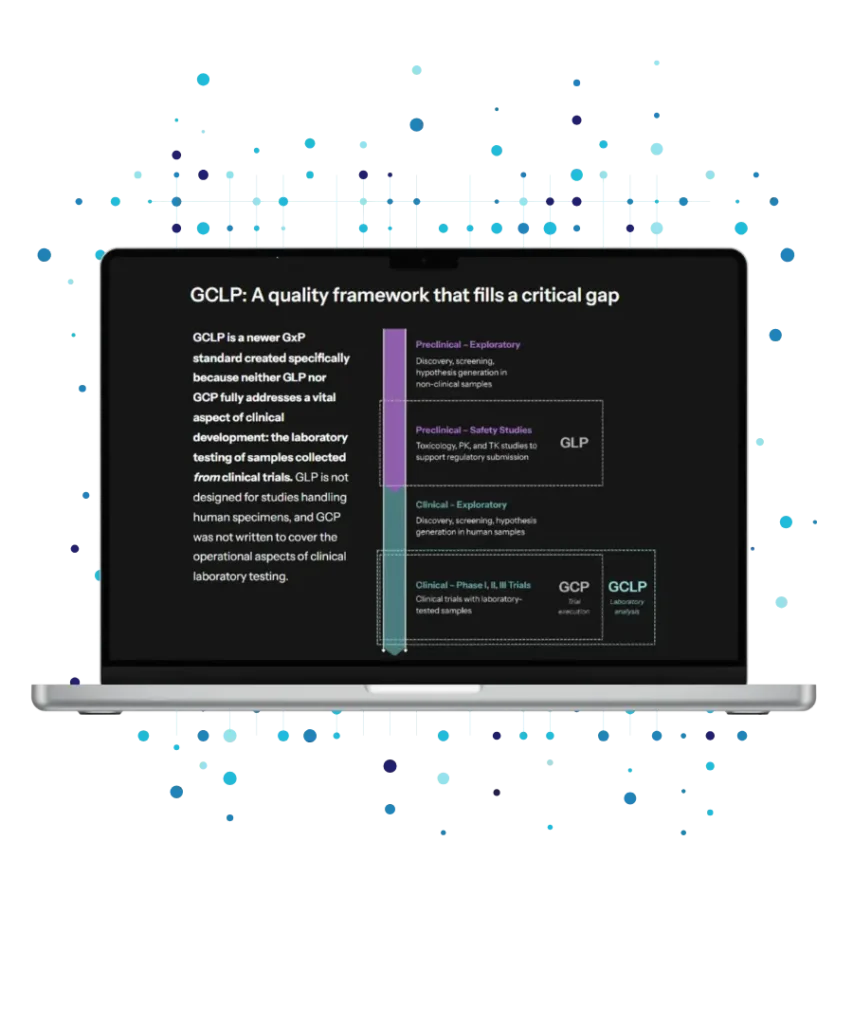
GCLP-compliant workflows for assays supporting clinical trials
See how these designated workflows meet WHO’s GCLP guidance with enhanced quality and traceability standards required of assay data generated for clinical trials, including those supporting primary and secondary endpoints.
Rapid turnaround of quantitative assays for nearly any sample type.
Sapient’s off-the-shelf protein assays already encompass more than 12,000 proteins. Any of these assays can undergo further qualification based on your specific study, sample type, and regulatory requirements, including with absolute quantification.
We can also develop bespoke assays for difficult-to-measure proteins outside of our existing menu, including for non-canonical proteins. In addition to endogenous proteins of interest, our workflows also enable targeted measurement of viral proteins, bacterial proteins, and drug levels.
Importantly, Sapient can utilize our GCLP-compliant workflows to uphold the regulatory requirements for any targeted assay used to report results that inform the diagnosis or treatment of clinical trial participants, including those supporting primary and secondary endpoints.
Don’t see your protein of interest? Sapient offers custom protein assay services to develop bespoke & difficult-to-measure proteins, protein variants, and PTMs, including for multiplexed panels.
Absolute quantification of selected proteins.
While traditional antibody-based protein assays are indirect, Sapient’s mass spectrometry-based workflows leverage labeled peptides for direct quantitation of proteins of interest.
High sensitivity detection across a wide dynamic range.
We leverage next-generation mass spectrometry systems that significantly improve sensitivity, speed, and throughput to provide precise protein measurements at scale.
Reproducible measurement across large sample cohorts.
With the ability to process hundreds of samples per day, our targeted protein assays developed under GCLP are ideal for detecting and monitoring protein targets and biomarkers in large-scale population studies and clinical trials.
Why choose Sapient's targeted protein assay services?
Are not limited by epitope availability or antibody specificity
Eliminate issues with cross‑reactivity and non‑specific binding
Provide higher molecular specificity, including discrimination between isoforms and PTMs
Are more readily transferable across sample types, species, and study stages
This makes them especially well‑suited for biomarker validation, target engagement, and translational-to-clinical studies where precision and reproducibility are critical. They can also be used as a complement to orthogonally validate findings obtained through traditional assay approaches and to further probe the functional biology behind targeted proteins.
Can proteins be multiplexed into targeted panels?
Yes. Our targeted, quantitative protein assays can be multiplexed into customized panels, enabling the simultaneous measurement of multiple proteins within a single run. Panels can be designed based on biological pathways, disease areas, or study objectives to maximize data density while preserving quantitative rigor.
How long does it take to develop a new targeted assay?
Sapient offers >12,000 off-the-shelf assays already measured via our mass spectrometry platform that can be rapidly optimized to your specific study requirements. Timelines are also significantly shorter for bespoke custom assay development compared to traditional immunoassay workflows since no antibody development time is required.
Are these quantitative protein assays suitable for clinical studies?
Sapient offers robust research use only (RUO) assays to support clinical biomarker confirmation/verification. We can provide analytical validation of targeted protein assays with appropriate context of use (COU) statements.
This ensures that the targeted assay data we deliver is not only clinically meaningful, but clinically actionable.
How scalable are Sapient’s targeted protein assays?
Sapient’s high throughput mass spectrometry systems allow us to deliver precision protein measures at scale, processing hundreds of samples per day and providing an ideal solution for detecting and monitoring protein targets and biomarkers in large-scale population studies and clinical trials.
When do targeted assays require GCLP compliance?
Good Clinical Laboratory Practice (GCLP) addresses a vital aspect of clinical development: the laboratory testing of samples collected from clinical trials. It bridges the rigorous laboratory standards that Good Laboratory Practice (GLP) requires for non-clinical safety studies and the Good Clinical Practice (GCP) requirements for upholding ethical standards relating to participant rights and privacy in clinical trials. The goal of GCLP is to ensure the measures reported by a lab supporting active clinical trials – including for primary and secondary endpoints – are accurate, reliable, fully traceable, and in compliance with ethical consent.
GCLP applies to laboratory work that involves data generation in human samples to:
Determine trial eligibility, patient enrollment, or patient stratification
Support a primary, secondary, or safety endpoint
Make adaptive design decisions in trials
Support companion diagnostic development
It is important to note that GCLP runs in parallel with GCP – not replaces it – when a clinical trial involves testing of samples collected from human participants.
If you are unsure of the GxP framework(s) that apply to your study, Sapient’s team can help. We bring deep QA and regulatory expertise to help you navigate compliance requirements and right-fit quality standards to the phase of your program and planned use of your data.
Request a targeted protein assay or panel using the form.
For questions or to discuss a specific project, we encourage you to book a time to talk to our scientific team.