
Article | May 27, 2026
Targeted Mass Spectrometry Protein Assays: Why Drug Developers Are Moving Beyond ELISA
ELISA has been the default method for protein measurement in drug development for decades. It has proven reliability, is familiar to regulators, and there are validated assays for a vast number of targets. But when programs need to measure multiple proteins simultaneously, require sequence-level confirmation of what is actually being detected, or must measure targets for which no validated antibody exists, ELISA reaches its limits.
This is exactly where targeted mass spectrometry protein assays provide a critical advantage. These assays deliver multiplexed, sequence-confirmed, quantitative protein measurements – not only in plasma, but also tissue, CSF, saliva, and FFPE samples – without needing a separate antibody for each analyte. Mass spectrometry enables direct measurement of the protein itself, rather than an indirect readout based on antibody-protein binding, to optimize specificity and eliminate the risk of antibody cross-reactivity and/or non-specific binding.
What Are Targeted Mass Spectrometry Protein Assays?
Targeted mass spectrometry protein assays quantify specific, pre-selected proteins by measuring peptide sequences unique to each target. Rather than relying on an antibody to capture and detect the protein, the workflow uses liquid chromatography and mass spectrometry to identify and measure peptides that can only have come from the protein of interest. Proteins are extracted and digested into smaller peptides, then injected into the mass spectrometer for fragmentation and analysis. The resulting fragmentation patterns serve as a molecular fingerprint, confirming the identity and quantity of each target protein with peptide-level specificity.
This is the fundamental difference compared to affinity-based assays such as ELISA: proteins are identified by their actual molecular structure, not by antibody binding. Targeted mass spectrometry assays can be used to measure one to hundreds of proteins per sample injection, and with heavy isotope-labeled internal standards, absolute quantification is achievable with high precision and reproducibility.
ELISA vs. Mass Spectrometry: A Direct Comparison
The most practical way to understand when targeted mass spectrometry offers high utility is to compare it directly with ELISA on the dimensions that matter most in clinical drug development.
| Feature | ELISA Assays | Targeted MS Protein Assays |
|---|---|---|
| Protein Identity Confirmation | Indirect (antibody binding) | Direct (peptide sequence) |
| Multiplexing | 1-10 analytes per run | 1-200+ proteins per run |
| Antibody Required | Yes | No |
| Cross-Reactivity Risk | Present | Absent |
| PTM Measurement | Limited | Yes (phospho, glyco, etc.) |
| Sample Type Flexibility | Varies by antibody (primarily plasma) | Broad (plasma, tissue, FFPE, CSF) |
| Absolute Quantification | Yes (with standards) | Yes (with isotope standards) |
| GCLP Compatibility | Established | Established |
| Development Time for New Analytes | Weeks to months | Days to weeks |
The most fundamental difference between these assay approaches is how protein identity is confirmed. ELISA relies on antibody specificity, and if that antibody binds to unintended proteins that may have epitopes very similar to the target protein, it can quietly confound the data.
Mass spectrometry identifies proteins by the mass and fragmentation pattern of specific peptide sequences, eliminating ambiguity about what protein is actually being measured. This method provides a direct readout upon which high-confidence decisions can be made.
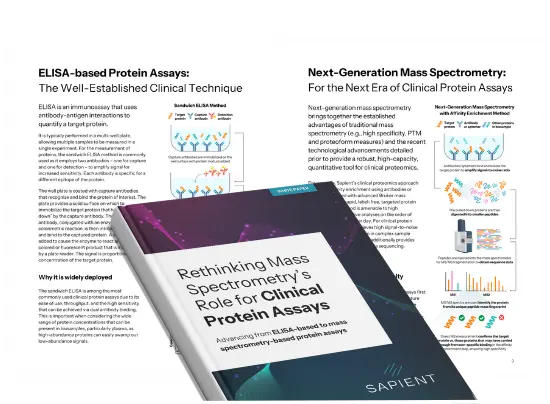
Download the white paper, “Rethinking Mass Spectrometry’s Role in Clinical Protein Assays”
When Targeted Mass Spectrometry Is the Right Choice
Targeted mass spectrometry protein assays are not a replacement for every protein measurement method. They are the right tool when the limitations of antibody-based assays create real risk for a development program, whether that stems from ambiguous protein identification, insufficient multiplexing, or gaps in validated antibody availability. Here are key scenarios where targeted mass spectrometry delivers the clearest advantage.
Measuring Multiple Proteins at Once
If a study is tracking more than a handful of proteins, running individual ELISA assays quickly becomes impractical. Targeted mass spectrometry can measure 50 to 200+ proteins in a single injection, making it far more efficient for assaying and monitoring pharmacodynamic panels, target engagement signatures, or companion diagnostic candidates.
Confirming Protein Identity
For regulatory or clinical contexts where certainty matters, peptide-level sequence confirmation provides something antibody-based assays simply cannot: direct proof of what is being measuring. This is especially important for novel targets, proteoforms, or proteins that have been modified post-translationally, where antibody specificity is difficult to guarantee. In fact, targeted mass spectrometry assays can complement ELISA readouts, providing orthogonal validation of antibody-based measurements.
When No Validated Antibody Exists
Antibody development and optimization takes time and does not always succeed. Mass spectrometry can measure any protein that produces detectable, unique tryptic peptides, including truncated isoforms and modified forms that lack commercially available reagents. New assays can be deployed within days to weeks, not months.
Measuring Post-Translational Modifications (PTMs)
When a program needs to track phosphorylation states, glycosylation patterns, or other modifications as part of a target engagement or mechanism-of-action study, targeted mass spectrometry can measure those modifications directly. These are the very signals that drive functional biology, and they are largely invisible to ELISA.
When ELISA Still Makes Sense
While targeted mass spectrometry solves problems that ELISA cannot, ELISA still remains one of the most widely validated, regulator-accepted, and operationally efficient protein measurement methods available. It keeps clear advantages in certain use cases including for:
- Measuring very low-abundance analytes in complex matrices, where antibody enrichment is necessary to reach the required sensitivity
- High-throughput single-analyte screening where per-sample speed and cost are the primary constraints
- Existing regulatory data packages where switching methods would require full re-validation
In practice, the two methods complement rather than compete with each other. Orthogonal validation across both platforms can often strengthen the data package for a program. A biomarker quantified by targeted mass spectrometry and independently confirmed by ELISA – or vice-versa – carries more weight with regulators, clinical teams, and partners than either measurement alone. Cross-platform concordance reduces the risk that a signal is an artifact of a single method’s limitations and is in fact a readout of meaningful biology.
Applications in Drug Development
Protein biomarkers touch nearly every stage of the drug development pipeline, from early target validation through pivotal clinical trials. Targeted mass spectrometry protein assays are purpose-built for the phases where the proteins to monitor have been defined and must be measured with precision, reproducibility, and regulatory-grade confidence.
| Key Application | Targeted MS Protein Assays |
|---|---|
| Pharmacodynamic (PD) Biomarkers | Quantify downstream protein changes that confirm a drug's mechanism-of-action in treated samples. |
| Target Engagement | Confirm a drug is binding its intended target by tracking changes in target abundance, modification state, or associated signaling proteins. |
| Safety Biomarkers | Monitor organ function markers across diverse sample types in preclinical and clinical safety studies. |
| Companion Diagnostics | Build multiplexed protein panels for patient stratification in CDx applications. |
| Translational Bridging | Run the same assay framework in mouse, NHP, and human samples to maintain continuity from preclinical studies into clinical development. |
Moving from Inference to Direct Measurement
The shift toward targeted mass spectrometry protein assays is not a trend; it is a response to a real gap in how drug development programs measure biology. Antibody-based methods have served the field well for programs needing to measure one or two proteins with established reagents. But as biomarker strategies grow more complex, multiplexing requirements increase, and regulatory expectations around analyte specificity tighten, the limitations of indirect detection become more pronounced.
Targeted mass spectrometry delivers sequence-confirmed protein identification, broad multiplexing, and flexibility across sample types, without waiting months for antibody development or introducing binding specificity risk into pivotal datasets. Whether used as a complement to ELISA or to overcome gaps in traditional antibody-based approaches, targeted mass spectrometry provides a measurement framework that is built for the complexity of modern drug development.
At Sapient, we have built a menu of over 12,000 off-the-shelf targeted mass spectrometry protein assays covering proteins across plasma, tissue, CSF, saliva, urine, and FFPE. Search for your protein of interest and learn how the assay can be optimized for your specific study.
Summary of Key Questions Addressed
What is a targeted mass spectrometry protein assay?
It is an analytical method that uses liquid chromatography and mass spectrometry to quantify specific proteins by measuring unique peptide sequences derived from those proteins. No antibodies are required, and anywhere from one to dozens to hundreds of proteins can be measured simultaneously with direct sequence confirmation.
How does targeted mass spectrometry compare to ELISA?
Targeted mass spectrometry can measure 50 to 200+ proteins per run versus 1 to 10 for ELISA, provides sequence-level protein identity confirmation, eliminates cross-reactivity risk, and works across a broader range of sample types. ELISA may still be the right choice for single-analyte, ultra high sensitivity measurements or established regulatory packages.
Can targeted mass spectrometry measure proteins in plasma?
Yes. Targeted mass spectrometry protein assays are routinely run on human plasma and serum. For low-abundance proteins, nanoparticle enrichment or immunodepletion of high-abundance proteins can improve detection sensitivity.
When should I use targeted proteomics instead of discovery proteomics?
Discovery proteomics is ideal for early-stage research as it allows for surveying the full proteome without preselecting proteins. Targeted proteomics ideal once a protein of interest or protein panel has been defined and needs to be quantified at scale, such as in a clinical study or for monitoring specific pharmacodynamic markers. At Sapient, we offer both, enabling a seamless path from discovery to validated assay.
Can targeted mass spectrometry and ELISA be used in the same study?
Yes. Many biomarker programs use both methods as part of an orthogonal validation strategy. A protein quantified by ELISA and independently confirmed by targeted mass spectrometry produces a stronger, more defensible data package than either method alone. Cross-platform concordance demonstrates that your signal is method-independent and represents reproducible biology.