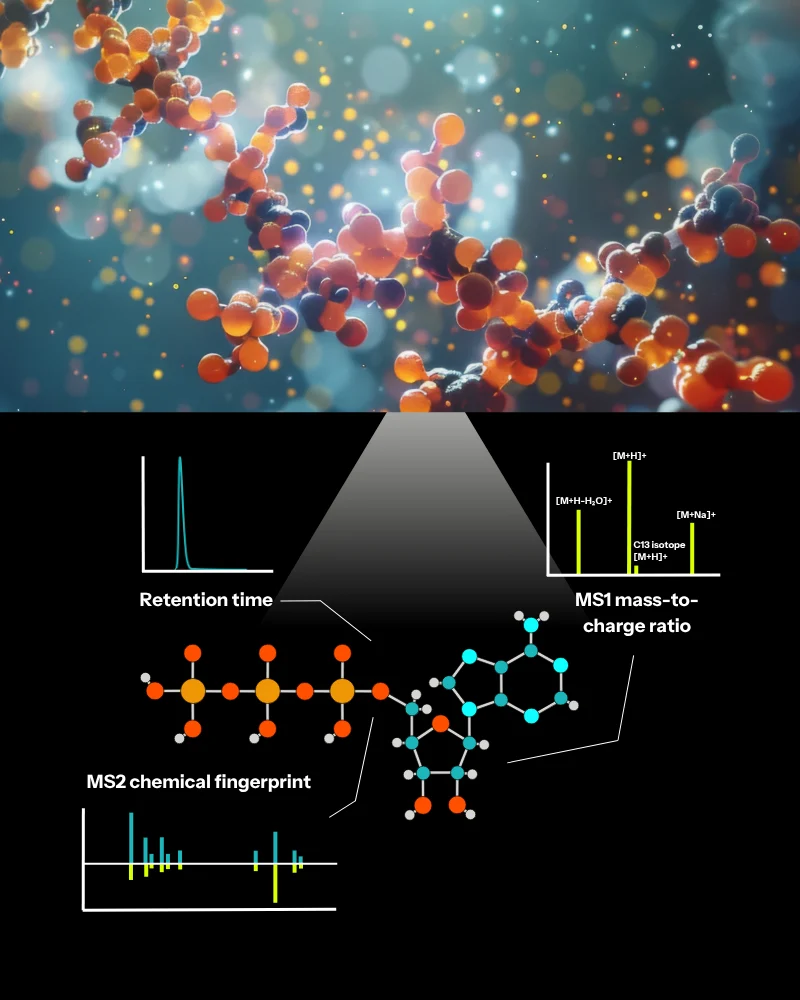
Accurate metabolite identification is needed to maximize the impact of discovery metabolomics studies, to effectively map the role of key biomarkers identified in a study and support translation to clinical use.
Enriched for key human metabolic pathways, biochemical processes, and disease drivers.
Using retention time (RT), MS1 mass-to-charge ratio (m/z), and MS2 data.
Enabling putative structural identification.
To identify unknown, biologically significant compounds observed in discovery studies and not yet captured in our reference databases.
These capabilities maximize the translatability of biologically significant metabolites and lipids identified through nontargeted discovery screenings.
This article details approaches to address and overcome the inherent complexities of metabolite identification, which can enhance the reliability and interpretability of discovery metabolomics data for drug development.
Accurate metabolite identification is central in mapping the biological role of discovered novel biomarkers and their involvement in disease processes, and to ensure the marker can be reproducibly measured in validation studies.
That is why we employ multi-parameter measures that build confidence in each identification. The molecule is matched to a reference standard under the same analytical conditions via multiple chemical parameters including RT, m/z, and MS2 chemical fingerprint to deliver a definitive identification and in turn, improve the biomarker’s translatability.
Bringing together these orthogonal datasets, we can assign MSI Tier 1 identifications to over 1,400 metabolites and lipids routinely measured in human biosamples.
All 13,000+ chemical reference standards in our in-house library have been extensively analyzed using Sapient’s rLC-MS systems, providing a rich dataset in which to perform matching.
All identified compounds undergo rigorous quality control including visual inspection as well as confirmation that no identified compound represents an isotope, adduct, or in-source fragment of another signal.

For molecules that remain unannotated after standards matching, Sapient leverages our database of over 6 million MS2 spectra across 850,000+ compounds to provide putative structural insights for hundreds to thousands of additional metabolites.
We can also perform structural elucidation to support advancement of important novel discoveries.
Tell us more about your project needs via the form, or click the button below to schedule a meeting with our scientists.
"*" indicates required fields