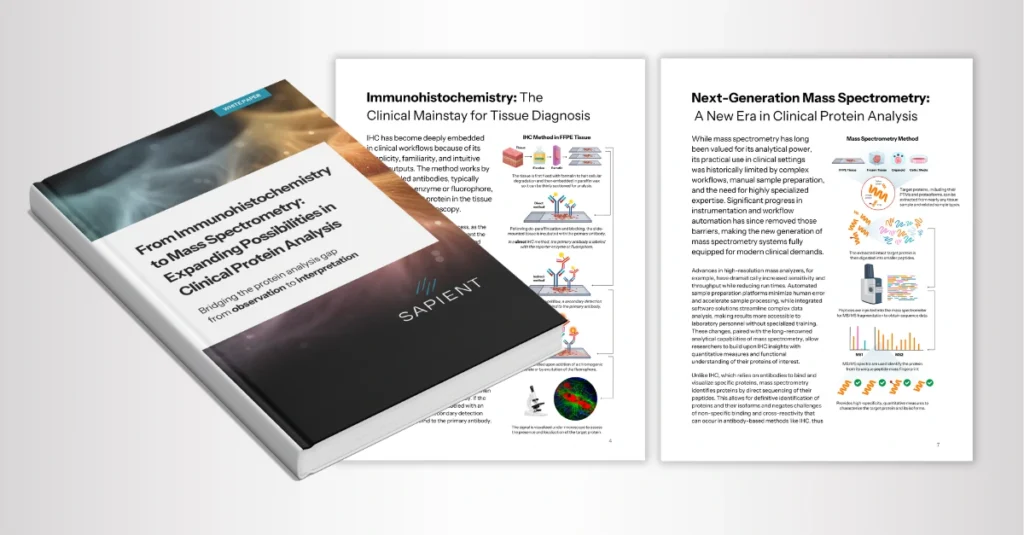
Accurate protein detection and characterization is essential to drug development and deployment, with protein biomarkers used to stratify patients, predict therapeutic response, and guide treatment decisions. Immunohistochemistry (IHC analysis) has long been the go-to clinical method to assess protein expression in tissue biopsy samples, particularly for oncology and immune-related diseases.
However, as the use of protein biomarkers in drug development and clinical medicine continues to evolve, demands for more precise, quantitative, multiplexed, and scalable measures for protein detection have increased – driving the need to look to technologies that can expand upon what IHC provides.
In this white paper, we explore why modern clinical research requires advanced protein assays that go beyond IHC analysis of protein presence and localization in tissue to enable quantification and functional interpretation of protein signals in the sample with high specificity, isoform-level resolution, and the ability to explore molecular complexity at scale. We also delve into the innovations that have now made mass spectrometry a clinically accessible platform to fill these gaps – no longer confined to the research realm but ready to drive next-generation clinical decisions.
Use the form to download the white paper and explore the differences of IHC analysis vs. mass spectrometry-based clinical protein assays, and how these approaches can deliver complementary insights to contextualize histological findings and ensure accurate interpretation for better decision-making.
High-specificity measure of protein abundance, including for post-translational modifications (PTMs) and protein isoforms, in correlation to prognosis or therapeutic response is key to driving better clinical decision-making. While IHC offers spatial context, it is a semi-quantitative, low-plex method that cannot readily detect PTMs and protein variants. Mass spectrometry, on the other hand, is built for this level of molecular precision. It can not only quantify protein abundance with high accuracy via direct peptide sequencing, but it also measures protein isoforms – including post-translationally modified, variant, or mutant forms – which are increasingly recognized to play important roles in biological processes and drug response, particularly in the oncology space.
Access the paper to read more!