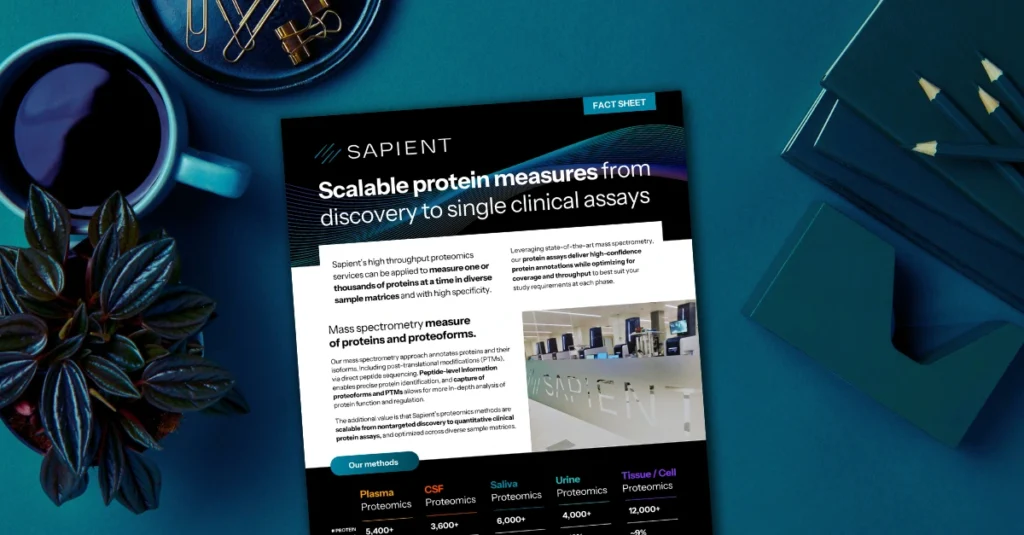
Leveraging state-of-the-art mass spectrometry, our high throughput discovery proteomics method can be applied to measure one or thousands of proteins at a time in diverse sample matrices and with high specificity. Our protein assays deliver high-confidence protein annotations while optimizing for coverage and throughput to best suit your study requirements at each phase.
Our mass spectrometry approach directly measures proteins and their isoforms, including post-translational modifications (PTMs), via peptide sequencing. Peptide-level information enables precise protein identification, and capture of proteoforms and PTMs allows for more in-depth analysis of protein function and regulation.
The additional value is that Sapient’s discovery proteomics services are scalable from nontargeted discovery to quantitative clinical protein assays, and optimized across diverse sample matrices. Your can choose the coverage depth and throughput that aligns with your specific study objectives.
Download the fact sheet to explore our specialized approaches for:
- Plasma Proteomics – enabling measure of 5,400+ protein groups, including >1,000 known and emerging drug targets
- CSF Proteomics – for discovery proteomics measures across 3,600+ protein groups, including >10 known and emerging drug targets for neurodegenerative diseases
- Saliva Proteomics – to measure 6,000+ protein groups via non-invasive sampling, including >800 known and emerging drug targets
- Urine Proteomics – for measure of 4,000+ protein groups in urine, including >500 known and emerging drug targets
- Tissue / Cell Proteomics – enabling deep measure of 12,000+ protein groups, including >1,000 known and emerging drug targets
Sapient’s label-free, DIA proteomics methods use nanoflow separation coupled to trapped ion mobility mass spectrometry and nanoparticle enrichment to enable measure of thousands of proteins across diverse bioanalytical pathways. Our data science team uses advanced statistical and machine learning (ML) models to perform biological pathway and drug target analyses to elucidate protein biomarkers and their involvement in processes underlying disease and drug response.
They can also combine discovery proteomics data with metabolomics, lipidomics, and genomics data as well as preclinical and clinical to inputs further validate and extend findings with rich multi-omics insights.