The saying “age is just a number” belies the true complexity of human aging. Individuals of the same chronological age can experience vastly different health trajectories, with some remaining mentally and physically vibrant well into late life, and others experiencing sharp health or quality of life declines decades earlier. Much effort has been made to develop aging clock models that can accurately predict biological age, which capture how various biological disruptions may accelerate aging based on how the body is actually functioning.
To date most aging clock models have relied on epigenetic markers, which have provided strong evidence that aging can be measured in molecular terms but still have shortcomings: specifically, it is unclear if they capture causal factors of aging, making it difficult to discern how interventions may slow or reverse aging. Given that metabolites and lipids provide dynamic readouts of both exogenous and endogenous factors – from genetics to environmental exposures and lifestyle – we set out to answer, can metabolomics data be used to predict individual biological aging rates?
This case study details the development of a machine learning (ML)-based metabolic aging clock model that can accurately predict accelerated biological aging for individuals with chronic disorders, with dynamic ‘reversal’ of accelerated aging following intervention.
Learn how Sapient trained this machine learning model on non-targeted, large-scale metabolomics datasets generated via rLC-MS in 1,640 samples from 887 healthy individuals, then applied the metabolic aging clock in a set of 4,000 individuals not seen by the model during training. In this cohort, the aging clock model predicted accelerated biological aging for individuals with common chronic disorders, consistent with reported lifespan reductions for those disease states.
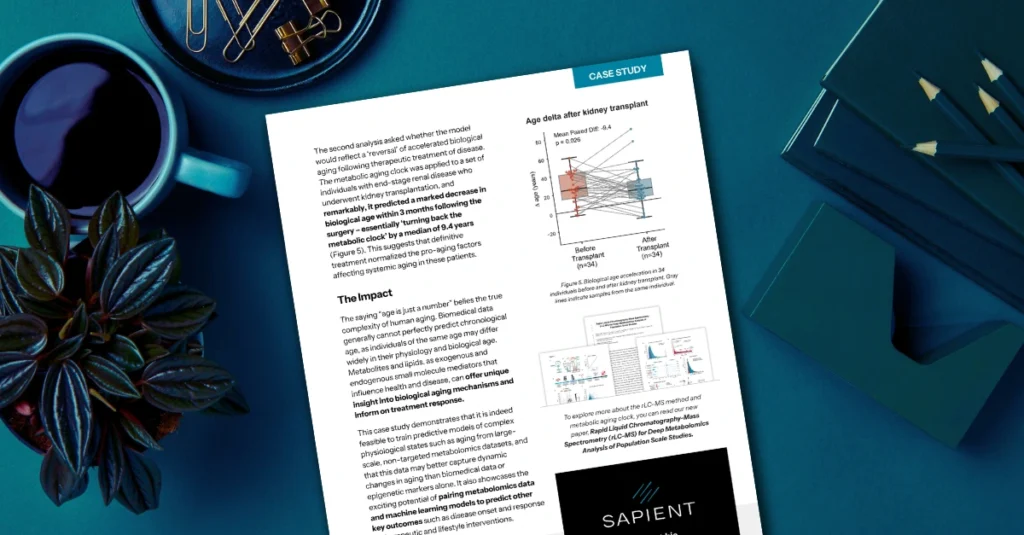
You’ll also see a second analysis where the metabolic aging clock was applied to a set of individuals with end-stage renal disease who underwent kidney transplantation, where it remarkably predicted a marked decrease in biological age within 3 months following the surgery – essentially ‘turning back the metabolic clock’ by a median of 9.4 years.
This case study demonstrates that it is indeed feasible to train predictive models of complex physiological states such as aging from large-scale, non-targeted metabolomics datasets, and that this data may better capture dynamic changes in aging than biomedical data or epigenetic markers alone. It also showcases the exciting potential of pairing such metabolomics data and machine learning models to predict other key outcomes such as disease onset and response to therapeutic and lifestyle interventions.
Complete the form to read the full case study!