Transform archival tissue into new discovery engines with direct measure of >10,000 protein groups in FFPE samples.
Formalin-fixed, paraffin-embedded (FFPE) tissue is one of the most accessible sample types available, but extracting protein insights from these biospecimens is challenging. Sapient’s next-generation mass spectrometry-based FFPE Proteomics workflow overcomes both fixation effects and coverage limitations via the direct measure of thousands of proteins in thousands of diverse FFPE tissue and tumor samples.
Now, we can unlock functional biology from proteins in FFPE tissue that are not captured by traditional DNA sequencing, RNA-seq, or immunohistochemistry (IHC) approaches, including quantification of protein expression, protein isoform variants, and post-translational modifications (PTMs).
Bring new tissue-derived insights to light.
Sapient FFPE Proteomics enablesquantification of target expression, pathway activation, post-translational signaling, and drug response in FFPE tissues with coverage comparable to fresh-frozen tissue, revealing functional insights that were previously hidden in these archival samples.
Go beyond the canonical proteome.
Our mass spectrometry method enables peptide-level analysis to capture phospho-, glyco-, and non-canonical protein variants which may represent key or novel biomarkers and targets.
Achieve protein- and pathway-level resolution.
Proteins measured by our FFPE Proteomics method include 200+ oncogenes and 500+ approved drug targets, with comprehensive detection of hundreds of oncogenic and immune signaling pathways.
No samples? No problem.
Sapient offers streamlined access to thousands of annotated FFPE tumors and tissues including through our DynamIQ™ virtual biobank. We will help you rapidly tap into the diverse global inventory of existing archival tissue samples to support your specific study needs.
Diverse tumor samples across grades / stages and types, including lung, gynecologic, GU, breast, colorectal, skin, and pancreatic cancers
Normal human tissues to support global differential analyses
Samples linked with histological and pathological data as well as clinical outcomes
For comprehensive biological insights across development phases.
Sapient enables pharma oncology teams to extract quantitative pathway activation and target discovery and validation data from FFPE tissues – whether new collections or from samples already used for genomics or IHC – turning archived tissue into functional translational data for both retrospective and prospective analyses.
From target discovery to functional validation, in weeks.
Discovery oncology scientists are under pressure to identify and validate novel drug targets, but with limited protein-level insights, programs often advance targets with incomplete functional validation, leading to high failure rates in translation.
What if you could turn FFPE tissue into a discovery engine to identify and functionally validate protein targets for higher confidence – without waiting for new sample collections?
Why not de-risk and accelerate your path from target nomination to functional validation in weeks, not months, with Sapient?
Obtain rapid proof-of-mechanism and target engagement insights.
Translational oncology teams must show that a therapeutic engages its target and modulates downstream pathways in patient tissue, but lack of protein-level insights means uncertainty around proof-of-mechanism, delaying or obscuring go/no-go decisions.
What if you could confirm target engagement and pathway modulation in FFPE tissue, retrospectively, before committing to costly Phase 2 trials?
Why not accelerate proof-of-mechanism with quantitative pathway and TE data in your FFPE samples or ours?
Optimize patient selection precision and trial success.
Clinical oncology programs require robust biomarkers for patient stratification and PK/PD data to guide enrollment, dosing, and patient response. A lack of protein-level insights slows identification of target engagement, and can lead to missed responder subgroups.
What if you could unlock new biomarker insights and responder profiles from archived trial samples – without adding new patient burden?
Why not optimize patient stratification and dosing through rapid, deep protein analysis of existing FFPE trial samples with Sapient?
Extend molecular insights and sample value with FFPE proteomics.
Precision oncology leaders have revolutionized genomic and transcriptomic profiling of FFPE tumors, yet they face the same strategic limitations: a lack of robust protein-level data means incomplete molecular insight for pharma partners and clinicians, and unrealized value from existing datasets and biobanks.
What if you could extend genomics insights already generated from your FFPE biorepositories by adding functional measures of tumor biology and drug response?
Why not extract new value from under-leveraged FFPE archives with Sapient?
Our FFPE proteomics seamlessly integrates with other omics offerings available through Sapient, including:
This multi-omic integration enables reconstruction of tumor biology from mutation to pathway activation, cell-type, and spatial localization, creating a unified molecular map of each tumor.
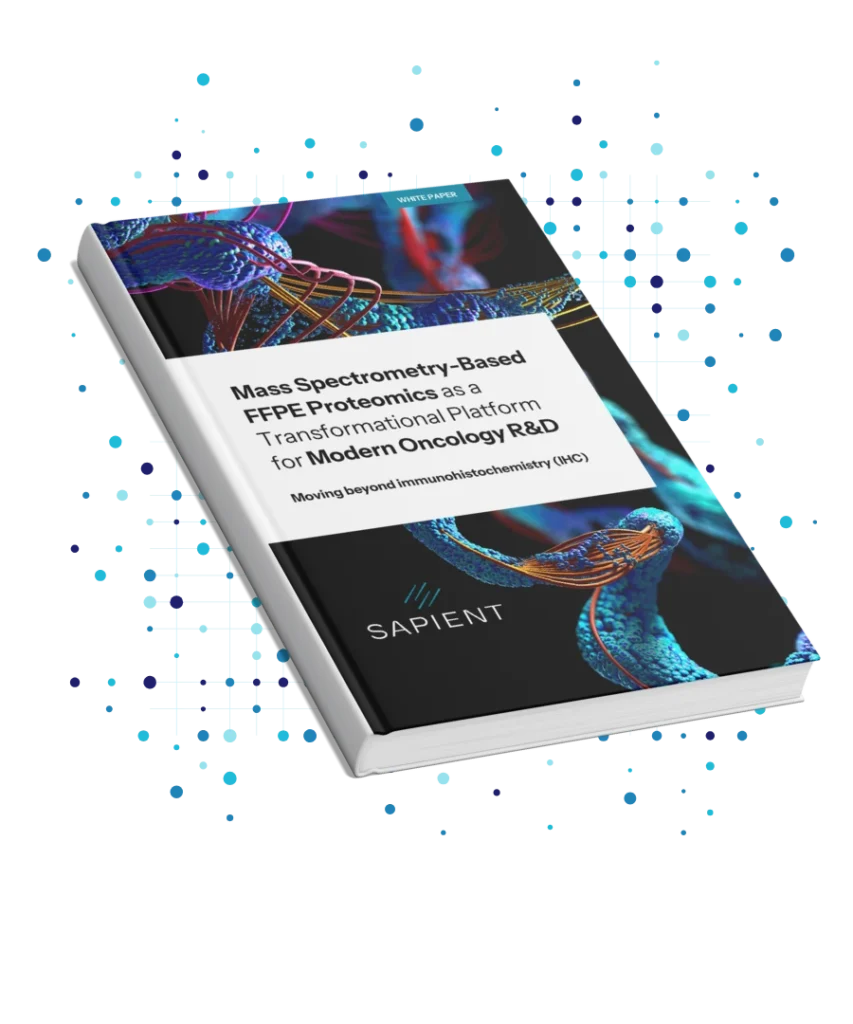
Mass Spectrometry-Based FFPE Proteomics as a Transformational Platform for Modern Oncology R&D
Explore how the emergence of clinically robust MS-based FFPE proteomics represents a pivotal moment for oncology.
For the first time, it is possible to directly quantify the functional protein landscape of a tumor, including protein isoforms, PTMs, signaling pathway activation, immune cell states, and resistance mechanisms. See how.
What makes our FPPE Proteomics platform revolutionary in the market?
Faster validation, deeper biological insight, and rapid access to annotated tumor samples, without new collections.
Connect with our scientists to discuss your project and how we can help you turn archived FFPE samples into new discovery engines – unlocking previously hidden protein-level insights that add the critical layer of functional biology to existing genomics datasets.