
Article | August 26, 2025
Enhancing Omics Data Integrity: A Principled Approach to PCA-Based Quality Assessment
Authored by Shaun Chen, PhD, Data Scientist II and Cameron Lamoureux, PhD, Senior Data Scientist, Sapient
In omics data analysis, Principal Component Analysis (PCA) serves as an indispensable tool for quality assessment and exploratory data analysis. Beyond its traditional role in dimensionality reduction, PCA provides critical insights into data structure, revealing batch effects, sample outliers, and underlying biological patterns. Without systematic application of PCA-based quality assessment, technical artifacts can masquerade as biological signals, leading to spurious discoveries and irreproducible results. Conversely, true biological outliers may be inappropriately removed if not properly distinguished from technical outliers. Therefore, establishing a principled workflow for PCA-based quality assessment is essential for generating credible insights from omics data.
Simplifying the Complex to Identify & Explain Variance
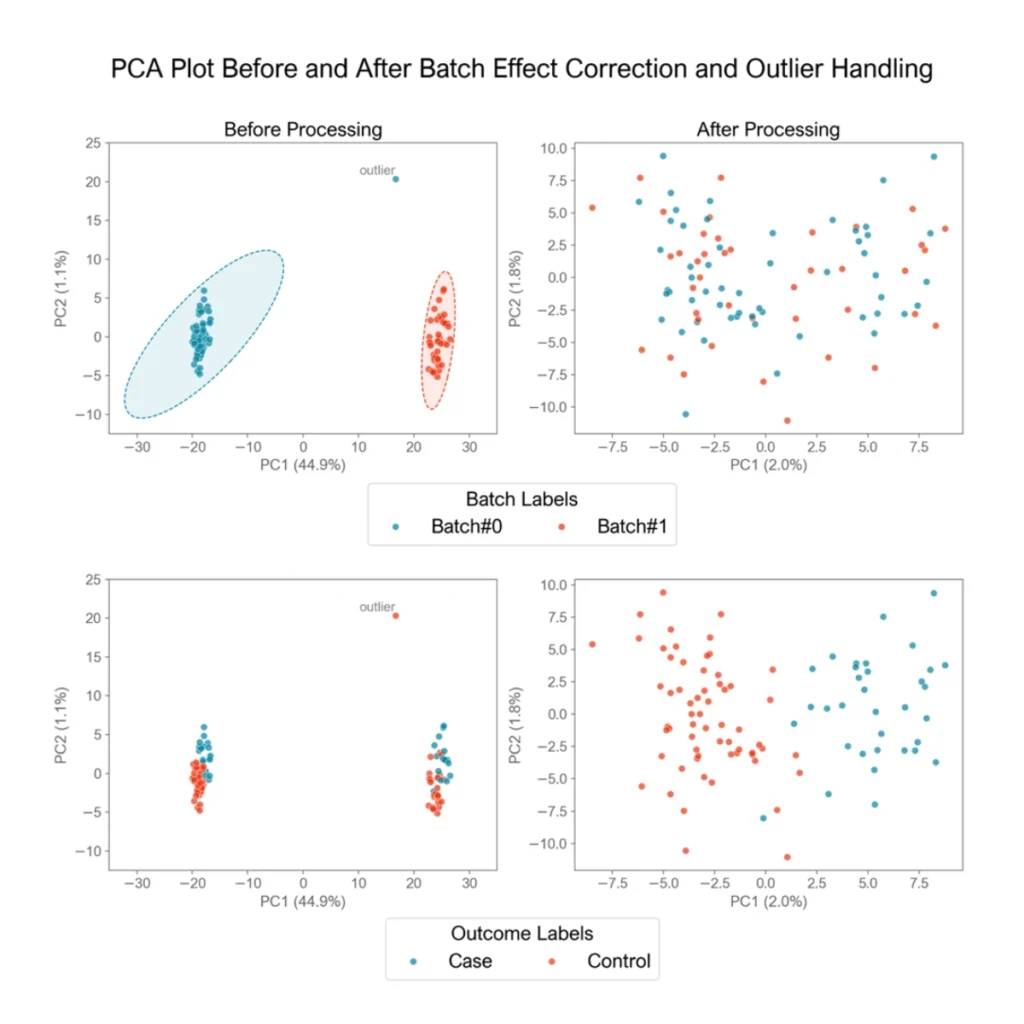
PCA transforms high-dimensional omics data into a lower-dimensional space. In this space, the features (e.g. metabolites, proteins, RNA transcripts, genetic variants etc.) that contribute most to the variance in the original dataset are highlighted. Through this lens, patterns amongst the samples in the dataset may be observed. These patterns may be biological in nature – different treatment groups, different timepoints – or they may be technical. Batch effects – systematic technical variations introduced during sample collection, processing, or measurement – often manifest as distinct clusters of samples in principal component (PC) space. Additionally, PCA-based workflows can readily identify sample outliers; they typically appear as isolated points distinct from the main sample distribution.
The PCA Quality Assessment Workflow
Effective PCA-based quality assessment consists of three key components:
(1) PCA Computation and Visualization
PCA computation begins by centering and scaling the preprocessed feature data to ensure all features contribute equally, regardless of their original scale. The algorithm then decomposes the data matrix into principal components, which are ordered by the amount of variance they explain in the dataset. Notably, omics datasets often contain tens of thousands of features and hundreds or thousands of samples, presenting computational challenges for standard PCA. Our pipeline is designed to efficiently handle this scale, enabling robust and reproducible PCA even for large datasets. By visualizing samples in the space of the first two principal components (a PC plot), researchers gain a high-level overview of the major sources of variation across all samples and features, making it easier to detect patterns, clusters, and potential outliers.
(2) Outlier Identification and Evaluation
Outlier identification in PC plot analysis involves flagging samples that are markedly different from the main population. A threshold-based approach using standard deviation ellipses in PCA space provides a quantitative way to highlight such outliers.
- Standard Deviation Threshold Method: Multivariate standard deviation ellipses can be calculated in PCA space, with common thresholds at 2.0 and 3.0 standard deviations, corresponding to approximately 95% and 99.7% of samples as “typical,” respectively. Samples outside these thresholds are flagged as potential outliers and should be carefully examined in the context of available metadata and experimental design.
- Group-Specific Considerations: When biological groups have inherently different variance structures (for example, samples collected at different timepoints), applying group-specific thresholds can prevent inappropriate flagging of samples that are normal within their group but appear outlying compared to the entire dataset.
(3) Batch Effect Identification and Correction
Batch effects are systematic technical differences introduced during sample collection, processing, or measurement that can confound biological interpretation. In PCA plots, batch effects are often identified when samples cluster according to batch labels rather than biological variables of interest.
- Batch effects can mask true biological outcomes: When batch effects are present, samples may form distinct clusters by batch, even if the biological outcome (e.g., case vs. control) is evenly distributed within each batch. This can obscure or “mask” real biological differences, making it difficult to detect meaningful associations.
- Batch correction: Once batch effects are identified – such as a systematic shift in intensity values between batches – a straightforward correction is median normalization, which adjusts each batch to a common scale. This approach is effective when the primary difference is a global shift. Batch correction remains a complex topic, especially when batch effects are entangled with biological variables and confounding is present. Careful evaluation is always recommended to ensure that correction methods address technical variation without distorting true biological signals.
Why PCA Over t-SNE and UMAP for Quality Assessment?
PCA is one of several dimensionality reduction techniques that can be used to simplify large-scale datasets; other approaches such as t-distributed stochastic neighbor embedding (t-SNE) and Uniform Manifold Approximation and Projection (UMAP) each have unique characteristics and use cases. While t-SNE and UMAP excel at visualization, PCA remains superior for quality assessment due to three key advantages: (1) Interpretability—PCA components are linear combinations of original features, allowing direct examination of which measurements drive batch effects or outliers; (2) Parameter stability—PCA is deterministic while t-SNE/UMAP depend on hyperparameters that can be difficult to select appropriately; (3) Quantitative assessment—PCA provides objective metrics through explained variance and statistical outlier detection, enabling reproducible decisions about sample retention.
In the rapidly evolving landscape of omics research, ensuring data integrity is paramount. PCA offers a powerful, interpretable, and scalable framework for identifying batch effects and outliers before downstream analysis. By adopting a systematic PCA-based workflow, researchers can safeguard against misleading artifacts, preserve true biological signals, and enhance the reproducibility of their findings. As omics datasets continue to grow in complexity and scale, integrating robust quality assessment practices like PCA is not just beneficial—it is essential for credible scientific discovery.